Showing posts with label Biomolecules. Show all posts

Wednesday, March 20, 2013

Xanthoproteic Test for Tyrosine and Tryptophan

298 comments

Reaction of concentrated nitric acid with some substituted aromatic rings gives a yellow color (Xanthos = yellow in Greek).

Procedure

    Set up test tubes as follows: In one tube put 2 drops of tryptophan solution, in another 2 drops of unknown compound, in another 2 drops of glycine solution, and in another about 5 mg tryosine powder. Then with great care, add 1.0 mL concentrated nitric acid (HNO3) to each test tube. Hold the tubes so that they do not point at you or anyone else.  Heat the tubes gently in a water bath until they boil. Cool the tubes slowly and add the 4% NaOH, drop by drop, until the solutions are alkaline. 

Did any color change take place before the alkali was added? What was the final color of each of the solutions?

Download Free here: Color Reactions of Amino acids

For More: See the Amino acids Video Lectures

See the Practical Video Presentation for better understanding

Friday, August 5, 2011

Lecture - 11 Enzyme Mechanisms II

0 comments

Lecture - 11 Enzyme Mechanisms II


Lecture - 10 Enzyme Mechanisms I

0 comments
Lecture - 10 Enzyme Mechanisms I

Lecture - 19 Vitamins and Coenzymes II

0 comments
Lecture - 19 Vitamins and Coenzymes II


Lecture - 18 Vitamins and Coenzymes 1

0 comments
Lecture - 18 Vitamins and Coenzymes 1


Lecture - 15 Membrane Transport

0 comments

Lecture - 15 Membrane Transport


Friday, December 3, 2010

Video lecture : Lipids and Membranes 1

0 comments

The lipids are important constituents of the diet because of their high energy value and also because of the fat-soluble vitamins and the essential fatty acids found with the fat of the natural foodstuffs. In the body, the fats serve as efficient source of energy which is stored in the adipose tissues.

Lipids are not generally classed as macromolecules, even though they share some of their features: for example, most are synthesized as linear polymers of a smaller molecule (the acetyl group on acetyl-CoA), and they self-assemble into larger structures (membranes).

Definition:

The lipids are a heterogeneous group of compounds related to fatty acids and include fats, oils, waxes and other related substances. These are oily or greasy organic substances, relatively insoluble in water and considerably soluble in organic solvents like ether, chloroform and benzene.

They are, thus, hydrophobic in nature. These are variously called as lipins or lipoids. The latter term is, however, sometimes used to refer “fat-like” substances which may not actually be related to the fatty acids. The term ‘lipid’ was first used by the German biochemist Bloor in 1943 for a major class of tissue components and foodstuffs.

lipids are molecular organic compounds, composed largely of carbon and hydrogen, that are essential for cell growth. Lipids are non-soluble in water and combine with carbohydrates and proteins to form the majority of all plant and animal cells. Lipids are more commonly synonymous with the word "fats" when speaking in terms of personal health, and though all fats are lipids, not all lipids are fats.

The three major purposes of lipids are energy storage, cell membrane development, and serving as a component of hormones and vitamins in the body. In healthcare, physicians order lipid tests or lipid profiles to measure cholesterol and triglycerides in a person's blood. Lipoprotein is the medical term used to define a combination of fat and protein.

Cholesterol is a naturally occurring substance in the body and is comprised of lipids. Cholesterol is separated into two types, high-density lipoprotein (HDL) and low-density lipoprotein (LDL). In a lipid test, the lipoproteins are separated so the level of each can be measured. Lipid tests are often part of preventative routine care, as they help determine whether there is significant risk for atherosclerosis, a hardening of the arteries that interferes with or interrupts blood flow. Lipoprotein levels are measured and dietary changes are usually in order when total cholesterol levels approach or rise above 200 milligrams per decilitre in the blood.

Fatty acids, also comprised of lipids, are an important dietary concern. Some fatty acids are essential and others are harmful. Fatty acids are categorized as mono-saturated, mono-unsaturated, and poly-unsaturated. Some essential fatty acids cannot be created by the body, and must be consumed in the diet. These include linoleic acid and alpha-linolenic acid.


Lipids & membranes 1

Lecture Series on BioChemistry I by Prof.S.Dasgupta, Dept of Chemistry, IIT Kharagpur.

Tuesday, November 30, 2010

Nucleic Acids Lecture III

0 comments
Nucleic Acids Lecture III

Lecture Series on BioChemistry I by Prof.S.Dasgupta, Dept of Chemistry, IIT Kharagpur. For more details on NPTEl visit http://nptel.iitm.ac.in

Nucleic Acids Lecture II

0 comments

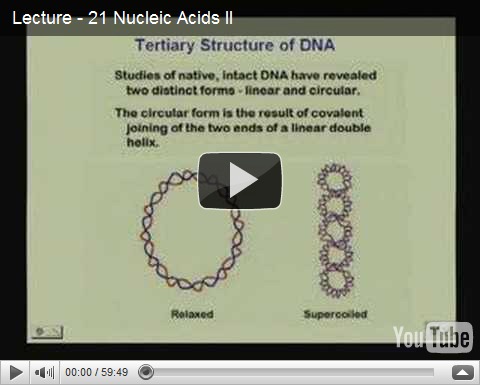
Nucleic acids Lecture II

Lecture Series on BioChemistry I by Prof.S.Dasgupta, Dept of Chemistry, IIT Kharagpur. For more details on NPTEl visit http://nptel.iitm.ac.in

Monday, November 29, 2010

Nucleic Acids Lecture I

0 comments
Nucleic acids Lecture I

Lecture Series on BioChemistry I by Prof.S.Dasgupta, Dept of Chemistry, IIT Kharagpur. For more details on NPTEl visit http://nptel.iitm.ac.in

Carbohydrate Lecture II

0 comments
Carbohydrate lecture II

Lecture Series on BioChemistry I by Prof.S.Dasgupta, Dept of Chemistry, IIT Kharagpur. For more details on NPTEl visit http://nptel.iitm.ac.in

Carbohydrates lecture I

0 comments
Carbohydrates lecture I

Lecture Series on BioChemistry I by Prof.S.Dasgupta, Dept of Chemistry, IIT Kharagpur. For more details on NPTEl visit http://nptel.iitm.ac.in
Tuesday, November 23, 2010

Lecture Video - 3 Enzymes as Biocatalysts

0 comments

Monday, November 22, 2010

Lecture Video Enzymes II

0 comments

What is Enzymes?

0 comments

Enzymes are biological catalysts: this means that they speed up the chemical reactions in living things. Without enzymes, our guts would take weeks and weeks to digest our food, our muscles, nerves and bones would not work properly and so on - we would not be living!

A catalyst is any substance which makes a chemical reaction go faster, without itself being changed. A catalyst can be used over and over again in a chemical reaction: it does not get used up. Enzymes are very much the same except that they are easily denatured (destroyed: but do NOT use this word since the protein molecule is not broken down into amino-acids, it just loses it shape and will not work any more) by heat. Our enzymes work best at body temperature. Our enzymes also have to have the correct pH.

All enzymes are made of protein; that is why they are sensitive to heat, pH and heavy metal ions. Unlike ordinary catalysts, they are specific to one chemical reaction. An ordinary catalyst may be used for several different chemical reactions, but an enzyme only works for one specific reaction.

Human saliva contains an enzyme called amylase. This enzyme helps to turn starch into a sugar called maltose. When you swallow a mouthful of food, the amylase stops working because it is much too acid in the stomach pH 2. Amyalse works best in neutral or slightly alkaline conditions, i.e. at about pH 7. When your food gets into the small intestine, more amylase is made by the pancreas and this turns the remaining starch into maltose. Another enzyme (maltase) turns all this maltose into glucose. Glucose is then absorbed into the blood.

Enzymes in the human alimentary canal and what they digest:


Enzyme            Substrate

Amylase                          Starch

Maltase                            Maltose

Sucrase                          Sucrose

Lipase                             Fats

Pepsin                           Proteins


All animals, green plants, fungi and bacteria produce enzymes: so enzymes are not just about digesting food. The enzymes which we use to digest our food are extra-cellular, that means they are found outside cells. We also have enzymes inside our cells; these are intra-cellular enzymes. Enzymes are used in ALL chemical reactions in living things; this includes respiration, photosynthesis, movement growth, getting rid of toxic chemicals in the liver and so on.

Viruses are rather different, but you do not need to know much about them for GCSE, so just make sure that you don't catch any!

Enzymes must have the correct shape to do their job. They are made of proteins, and proteins are very easily affected by heat, pH and heavy metal ions. Some people say that enzymes work like a key in a lock. If the key has been twisted by heat, or dissolved in acid or stuck up with chewing gum it will not work. Enzymes change their shape if the temperature or pH changes, so they have to have the right conditions. Copper ions are poisonous: if you get copper ions in your blood they will block up some of the important enzymes in red and white blood cells.


See the Video Lectures on Enzymes

Enzymes part I

Enzymes Part II

Enzymes Part III : Enzymes as Biocatalysts

Enzymes Part IV

Enzyme Part V : Specificity of Enzyme Action

Enzyme Part VI : Kinetics of Enzyme Catalysed Reactions

Enzyme Part VII

Enzyme Part VIII

Lecture Video Enzymes I

0 comments
Lecture Series on BioChemistry I by Prof.S.Dasgupta, Dept of Chemistry, IIT Kharagpur. For more details on NPTEl visit http://nptel.iitm.ac.in

Sunday, November 21, 2010

Video Lecture : Protein Structure–I

0 comments
Protein Structure Video lecture I

Saturday, November 20, 2010

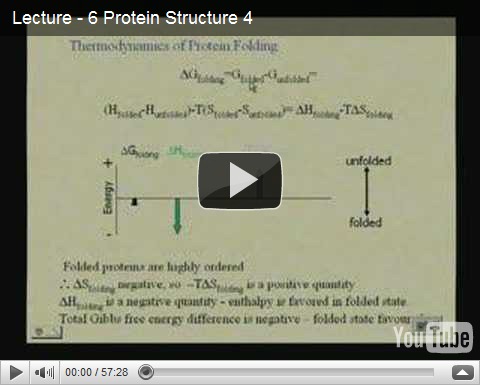
Video Lecture : Protein Structure 4

0 comments

Lecture Series on BioChemistry I by Prof.S.Dasgupta, Dept of Chemistry, IIT Kharagpur.

Protein Lecture IV

Video Lecture : Protein structure II

0 comments

Video Lecture : Protein Structure III

0 comments
Protein Structure III
 

Secret Class Room. Copyright 2008 All Rights Reserved Revolution Two Church theme by Brian Gardner Converted into Blogger Template by Bloganol dot com