
Free Biochemistry Video Lecture from IIT, Kharagpoor
Showing posts with label Biomolecules video lecture. Show all posts
Showing posts with label Biomolecules video lecture. Show all posts
Friday, August 5, 2011
Index of Free Biochemistry Courses video lectures
0
comments
Labels: Biochemistry Index, Biomolecules video lecture, Index of the Chapters, Video lectures
Labels: Biochemistry Index, Biomolecules video lecture, Index of the Chapters, Video lectures


Friday, December 3, 2010
Video lecture : Lipids and Membranes 1
The lipids are important constituents of the diet because of their high energy value and also because of the fat-soluble vitamins and the essential fatty acids found with the fat of the natural foodstuffs. In the body, the fats serve as efficient source of energy which is stored in the adipose tissues.
Lipids are not generally classed as macromolecules, even though they share some of their features: for example, most are synthesized as linear polymers of a smaller molecule (the acetyl group on acetyl-CoA), and they self-assemble into larger structures (membranes).
Definition:
The lipids are a heterogeneous group of compounds related to fatty acids and include fats, oils, waxes and other related substances. These are oily or greasy organic substances, relatively insoluble in water and considerably soluble in organic solvents like ether, chloroform and benzene.
They are, thus, hydrophobic in nature. These are variously called as lipins or lipoids. The latter term is, however, sometimes used to refer “fat-like” substances which may not actually be related to the fatty acids. The term ‘lipid’ was first used by the German biochemist Bloor in 1943 for a major class of tissue components and foodstuffs.
lipids are molecular organic compounds, composed largely of carbon and hydrogen, that are essential for cell growth. Lipids are non-soluble in water and combine with carbohydrates and proteins to form the majority of all plant and animal cells. Lipids are more commonly synonymous with the word "fats" when speaking in terms of personal health, and though all fats are lipids, not all lipids are fats.
The three major purposes of lipids are energy storage, cell membrane development, and serving as a component of hormones and vitamins in the body. In healthcare, physicians order lipid tests or lipid profiles to measure cholesterol and triglycerides in a person's blood. Lipoprotein is the medical term used to define a combination of fat and protein.
Cholesterol is a naturally occurring substance in the body and is comprised of lipids. Cholesterol is separated into two types, high-density lipoprotein (HDL) and low-density lipoprotein (LDL). In a lipid test, the lipoproteins are separated so the level of each can be measured. Lipid tests are often part of preventative routine care, as they help determine whether there is significant risk for atherosclerosis, a hardening of the arteries that interferes with or interrupts blood flow. Lipoprotein levels are measured and dietary changes are usually in order when total cholesterol levels approach or rise above 200 milligrams per decilitre in the blood.
Fatty acids, also comprised of lipids, are an important dietary concern. Some fatty acids are essential and others are harmful. Fatty acids are categorized as mono-saturated, mono-unsaturated, and poly-unsaturated. Some essential fatty acids cannot be created by the body, and must be consumed in the diet. These include linoleic acid and alpha-linolenic acid.

Lipids & membranes 1
Lecture Series on BioChemistry I by Prof.S.Dasgupta, Dept of Chemistry, IIT Kharagpur.
Tuesday, November 30, 2010
Nucleic Acids Lecture III
0
comments
Labels: Biomolecules, Biomolecules video lecture, Lectures, Nucleic Acids, Video lectures
Labels: Biomolecules, Biomolecules video lecture, Lectures, Nucleic Acids, Video lectures

Nucleic Acids Lecture III
Lecture Series on BioChemistry I by Prof.S.Dasgupta, Dept of Chemistry, IIT Kharagpur. For more details on NPTEl visit http://nptel.iitm.ac.in
Nucleic Acids Lecture II
0
comments
Labels: Biomolecules, Biomolecules video lecture, Lectures, Nucleic Acids, Video lectures
Labels: Biomolecules, Biomolecules video lecture, Lectures, Nucleic Acids, Video lectures
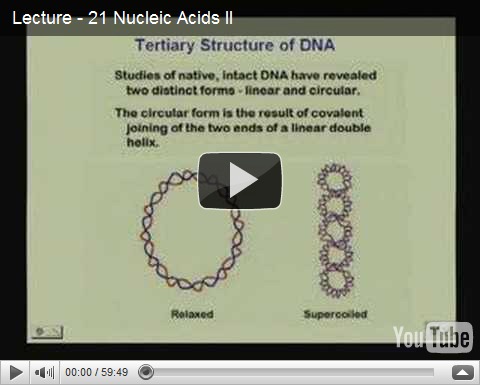
Nucleic acids Lecture II
Lecture Series on BioChemistry I by Prof.S.Dasgupta, Dept of Chemistry, IIT Kharagpur. For more details on NPTEl visit http://nptel.iitm.ac.in
Monday, November 29, 2010
Nucleic Acids Lecture I
0
comments
Labels: Biomolecules, Biomolecules video lecture, Lectures, Nucleic Acids, Video lectures
Labels: Biomolecules, Biomolecules video lecture, Lectures, Nucleic Acids, Video lectures

Nucleic acids Lecture I
Lecture Series on BioChemistry I by Prof.S.Dasgupta, Dept of Chemistry, IIT Kharagpur. For more details on NPTEl visit http://nptel.iitm.ac.in
Carbohydrate Lecture II
0
comments
Labels: Biomolecules, Biomolecules video lecture, Carbohydrates, Lectures, Video lectures
Labels: Biomolecules, Biomolecules video lecture, Carbohydrates, Lectures, Video lectures

Carbohydrate lecture II
Lecture Series on BioChemistry I by Prof.S.Dasgupta, Dept of Chemistry, IIT Kharagpur. For more details on NPTEl visit http://nptel.iitm.ac.in
Carbohydrates lecture I
0
comments
Labels: Biomolecules, Biomolecules video lecture, Carbohydrates, Lectures, Video lectures
Labels: Biomolecules, Biomolecules video lecture, Carbohydrates, Lectures, Video lectures

Carbohydrates lecture I
Lecture Series on BioChemistry I by Prof.S.Dasgupta, Dept of Chemistry, IIT Kharagpur. For more details on NPTEl visit http://nptel.iitm.ac.in
Tuesday, November 23, 2010
Monday, November 22, 2010

Lecture Video Enzymes I

Lecture Series on BioChemistry I by Prof.S.Dasgupta, Dept of Chemistry, IIT Kharagpur. For more details on NPTEl visit http://nptel.iitm.ac.in
Sunday, November 21, 2010

Saturday, November 20, 2010
Video Lecture : Protein Structure 4
Lecture Series on BioChemistry I by Prof.S.Dasgupta, Dept of Chemistry, IIT Kharagpur.
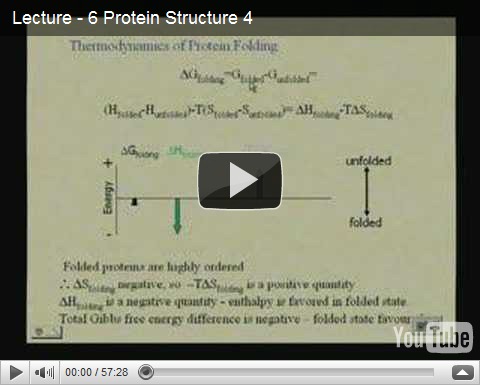
Protein Lecture IV

Friday, November 19, 2010
Subscribe to:
Posts (Atom)


